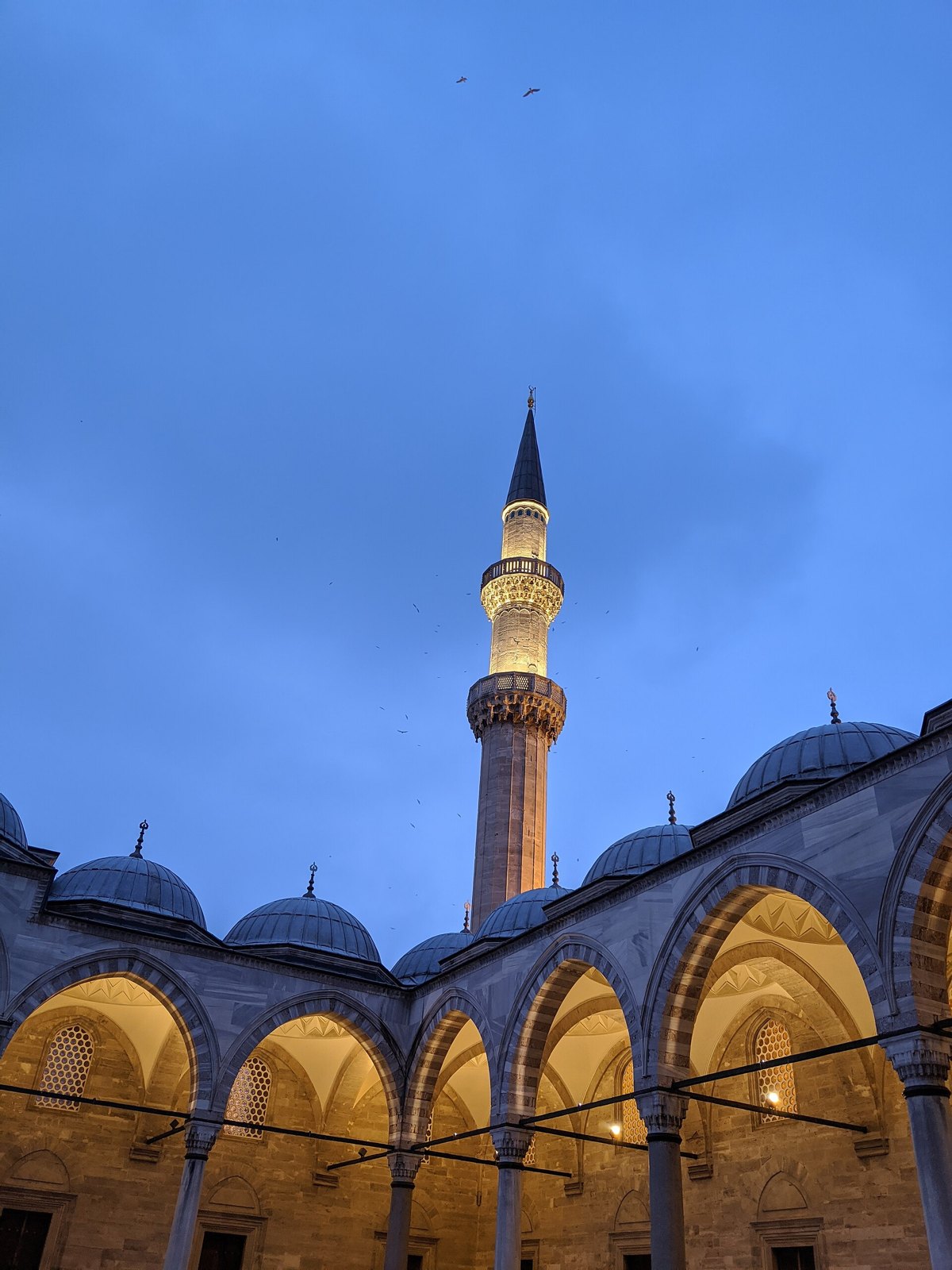
Istanbul’s working mosques are not open on a printed schedule — they close briefly, five times a day, for prayer, and those closures move with the sun rather than the clock. A visitor who treats prayer times as the city’s real opening hours, rather than checking a timetable, will read the day correctly. During Ramadan this entire framework changes shape: the city stops organizing itself around the five prayers and starts organizing itself around one meal, iftar, and that shift is sharp enough to catch out a traveller who assumes the normal pattern still holds.
The five prayers that structure the day
A working mosque in Istanbul closes to sightseeing visitors for a short window around each of the five daily prayers — fajr before sunrise, dhuhr at midday, asr in the afternoon, maghrib at sunset and isha at night — and for a longer period around the Friday midday prayer, when the congregation is largest. The call to prayer, the ezan, is sung live from each minaret by a muezzin and is audible across most neighbourhoods; it is the signal, not the instruction, and it marks the moment a mosque’s working rhythm takes priority over its role as a sight.
| Prayer | Turkish name | Rough position in the day |
|---|---|---|
| Dawn | Sabah / İmsak | Before sunrise |
| Midday | Öğle | Just after the sun is highest |
| Afternoon | İkindi | Mid to late afternoon |
| Sunset | Akşam | At sunset |
| Night | Yatsı | After dark |
None of these can be printed as a clock time in an article like this one, because they are set by the sun’s position, not a fixed hour, and they drift through the year — the gap between dawn prayer and night prayer is far wider in July than in December. Turkey’s Presidency of Religious Affairs, the Diyanet İşleri Başkanlığı, publishes the day’s exact times for Istanbul and every other province, and any serious prayer-times app simply pulls from that same official calculation. Checking the day’s times there, or in an app that cites it, is the only way to know when a given mosque will be closed to visitors that afternoon. The practical detail — what to wear, how long the closure runs, what a Harem-style side door is for — is covered in full in our guide to visiting a working mosque in Istanbul.
Why this matters for a sightseeing itinerary
Istanbul’s great mosques — the Blue Mosque, Süleymaniye, the many smaller neighbourhood mosques that fill in the gaps of the old city’s skyline — charge no admission at all; the Access Istanbul argument, made at length elsewhere on this site, is that the price of entry to these buildings is behaving like a guest rather than paying a fee. That only works if the visit is timed around the prayers rather than around them being ignored. A traveller who arrives at the start of the midday closure on a Friday will simply wait outside longer than on any other day of the week, and no fixed itinerary built around clock hours survives contact with that reality.
Ramadan breaks the pattern entirely
For one lunar month a year — the dates move by about ten or eleven days annually against the Gregorian calendar, so this site will not print them — the “read the prayer times” framework above stops being the useful one. During Ramadan, Istanbul does not reorganize itself around the five daily prayers; it reorganizes around a single moment, iftar, the breaking of the day’s fast at sunset, timed to the maghrib call to prayer. The whole rhythm of the city bends toward that one point in the evening, and the effect is visible on the street in a way the ordinary prayer schedule never is.
The shape of a Ramadan day in Istanbul runs roughly like this:
- Before dawn: sahur, the pre-dawn meal, with some restaurants and bakeries open in the small hours specifically for it.
- Through the day: a visibly quieter street-food scene in neighbourhoods with a high proportion of people fasting — fewer people eating in public, though plenty of restaurants continue serving visitors and non-fasting residents as normal.
- The final half hour to hour before sunset: restaurants and cafés audibly empty out, because people who are fasting are heading home, or to wherever they intend to break the fast, rather than sitting down to eat early.
- At the moment of maghrib: in Istanbul this is traditionally marked by a cannon, historically fired to announce the fast-breaking moment even to those out of earshot of the ezan. The instant it sounds, or the ezan is heard, tables that were empty fill at once.
- The hour or two after: the surge — restaurants at full capacity, often with set iftar menus, and a noticeably festive, late-evening street life once the meal is under way.
The practical consequence for a visitor is specific and worth planning around. Shops along İstiklal Caddesi and in the dense commercial streets of Fatih — the district that holds the highest concentration of mosques and of residents observing the fast — often shorten their afternoon hours and shutter ahead of sunset, reopening later in the evening once iftar is under way, rather than keeping the standard daytime hours this site describes in its bazaars and shopping coverage. The Grand Bazaar’s own weekly closure is unrelated to any of this — it is closed on Sundays year-round — but during Ramadan its last working hour before sunset is also visibly quieter as traders close up to get home for iftar.

Transport sees the same squeeze. In the twenty minutes or so before sunset, bridge traffic and the roads approaching the Bosphorus crossings back up noticeably as people rush to be home, or at a chosen table, before the cannon. The same compression hits the ferries: boats in the final run before sunset are busier than the equivalent service at any other time of day, for the same reason everyone wants to be across the water and at a table before the fast breaks. This is one more reason the ferries are worth understanding as ordinary transport rather than a scenic extra — see why the Bosphorus ferry is public transport, not a tour — because during Ramadan they are genuinely crowded commuter boats at that hour, not a quiet sightseeing ride. The same İstanbulkart used on the ferries and the bridge-adjacent metro lines covers all of it; what the card does and does not include is set out in how the İstanbulkart works.

Checking the day, not assuming it
Outside Ramadan, the one fact worth carrying is that prayer times are a sun-based schedule, not a clock-based one, published daily by Turkey’s Presidency of Religious Affairs and mirrored in any mainstream prayer-times app; checking the current day’s times, rather than relying on yesterday’s or a printed table, is the only reliable approach. Inside Ramadan, that same daily check still matters — maghrib is the moment the whole evening pivots on — but the far more useful habit is simply building slack into the last hour before sunset: expect restaurants to thin out, some shops to close early, and both bridges and ferries to be busier than usual, then expect everything to reopen, often with more life in the street than before, once the fast has broken. General groundwork for a first visit, including how the calendar and the two bayram holidays affect the whole city for several days at a stretch, is covered in our planning and practicalities archive; broader transport patterns, including how fares and transfers are structured, sit in the getting around archive. The municipal tourism authority, İstanbul’un resmi turizm portalı published by the city, also carries seasonal notices during Ramadan worth checking directly rather than through a secondhand summary.

Access Istanbul is an independent guide written from published, checkable sources. We have not visited the places described here and we do not publish personal recommendations or invented ‘local favorites’ — where something is singled out as notable, we say who says so. Opening times, fares, closures and prices change at short notice, so treat everything here as a starting point and confirm with the museum, operator or venue directly before building a day around it. We give no advice on visas, insurance, health or safety; use your own government’s official guidance for those.
Featured image: Photo by Mustafa-trit20, source, CC BY-SA 4.0
