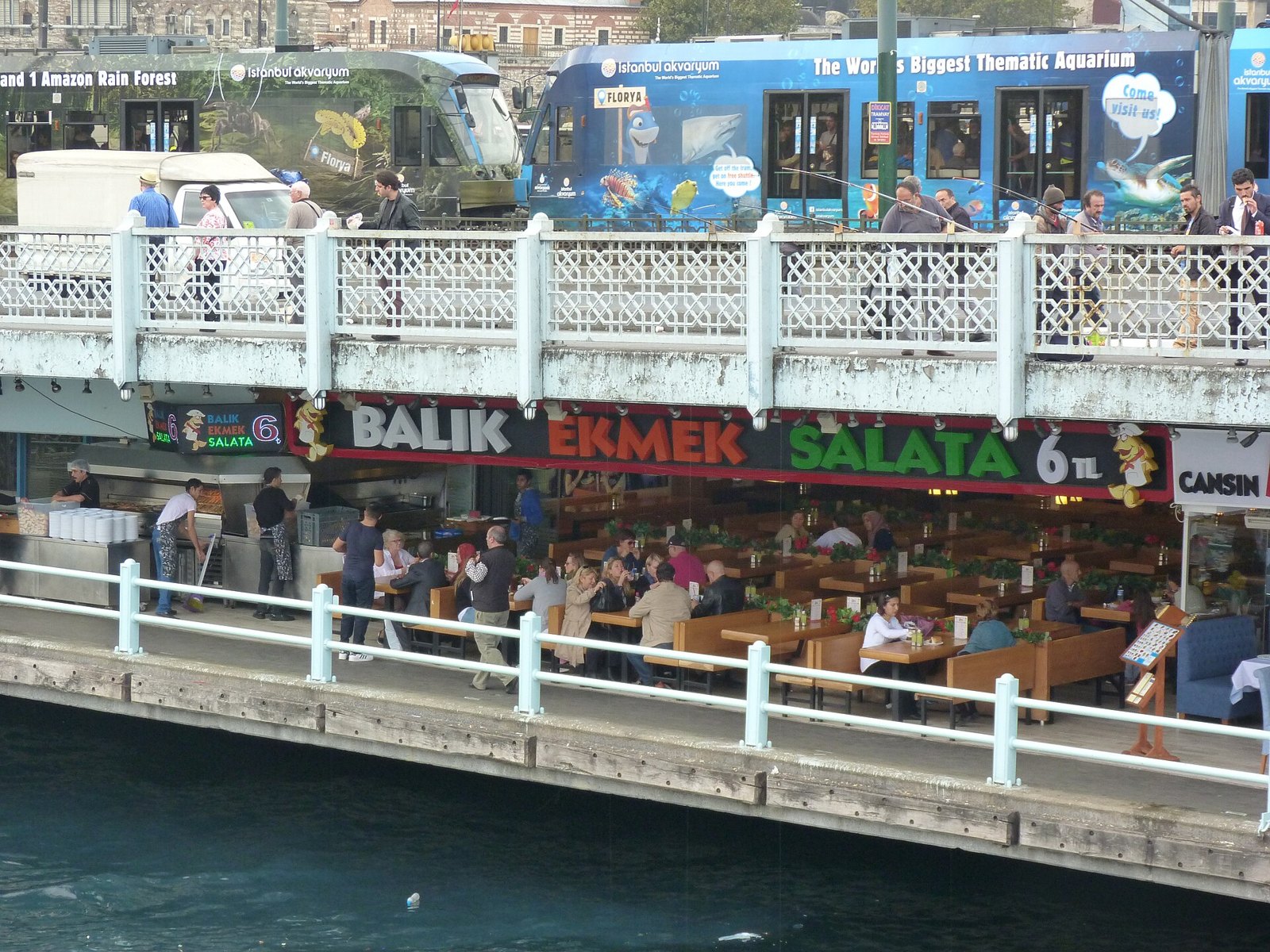
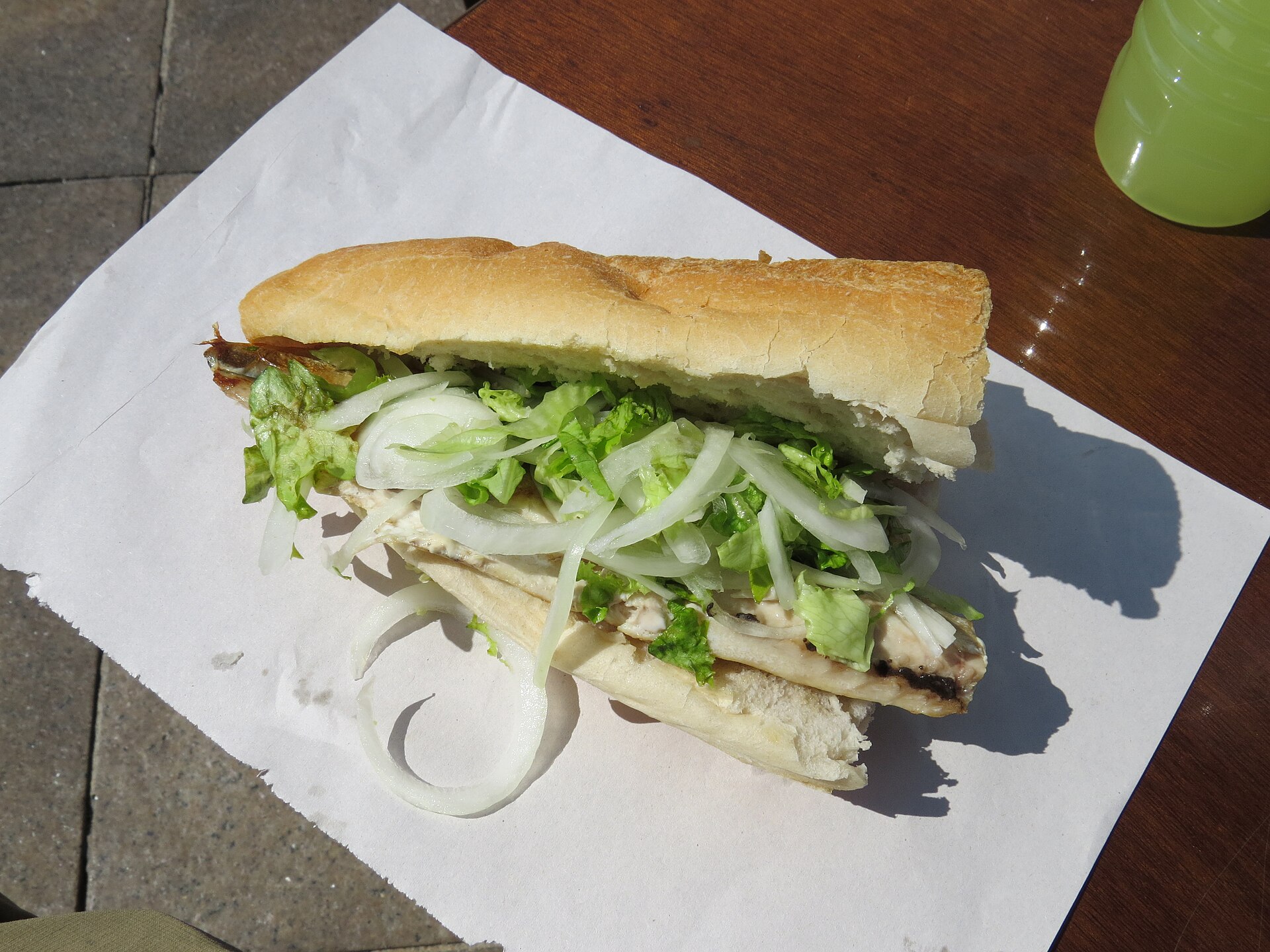
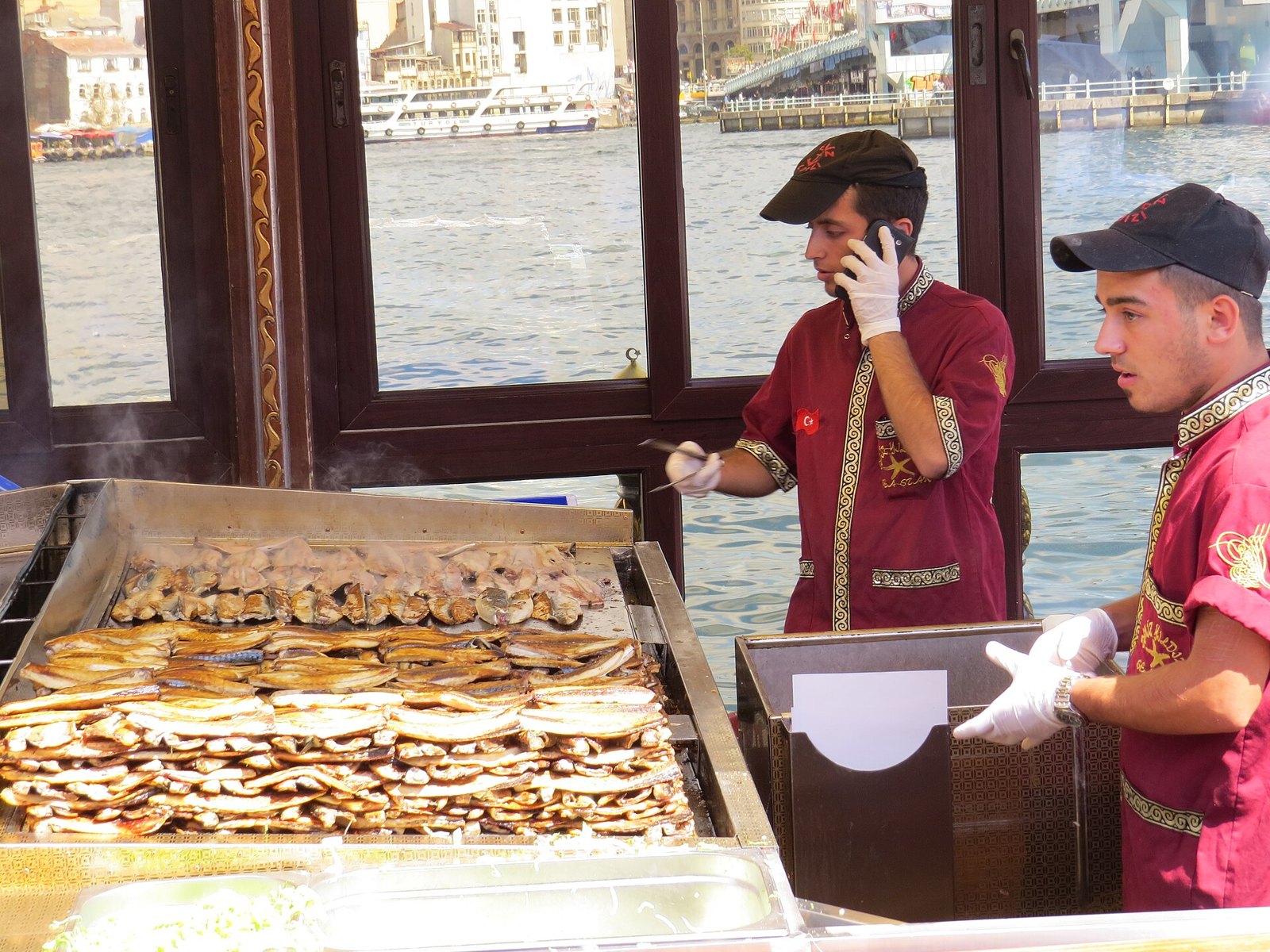
Balık ekmek is grilled or fried fish in half a loaf of bread, sold from boats moored along the Eminönü waterfront on the Golden Horn, just west of the Galata Bridge. You order at a window on the boat, hand over cash, and walk away with a sandwich. The trap starts after that: a table nearby that looks like part of the same operation usually belongs to a separate restaurant, and sitting down without checking can turn a cheap sandwich into a padded bill.
Where the boats actually are
The boats sit along the quay at Eminönü, on the European side, between the Galata Bridge and the ferry docks. This is the same stretch where the New Mosque (Yeni Cami) faces the water and where the Spice Bazaar’s entrances open onto the square. It is a working transit point, not a scenic backwater — trams, ferries and buses all converge here, and the fish boats have operated alongside that traffic for decades.
Eminönü is also where the T1 tram line crosses the district on its way between Kabataş and Sultanahmet, and where several public ferry lines dock. Both use the İstanbulkart, the city’s single transport card, and the crossing itself costs the same as any other ferry ride. Our guide to how the İstanbulkart works and what it doesn’t cover explains the card in full.
How the sandwich is actually served
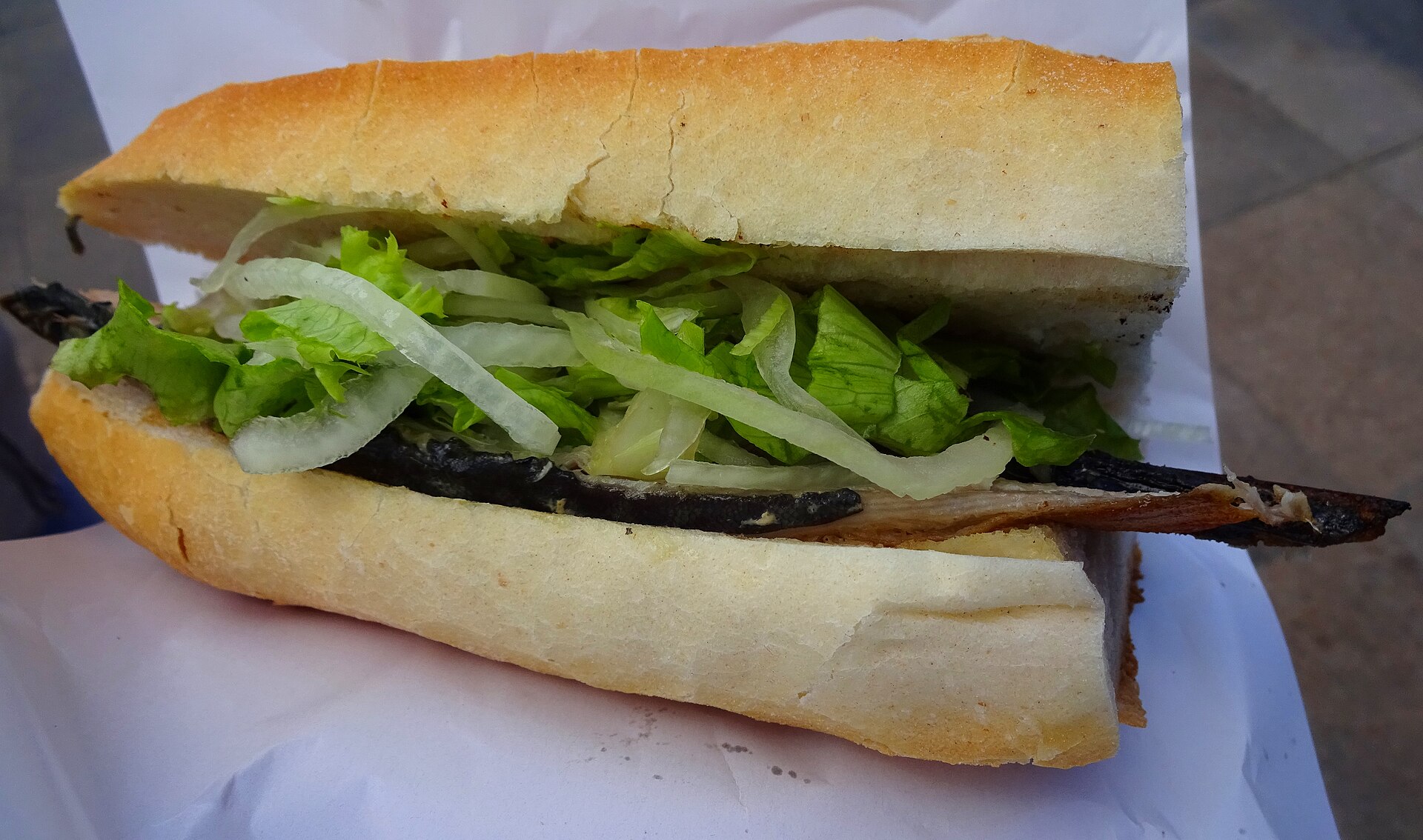
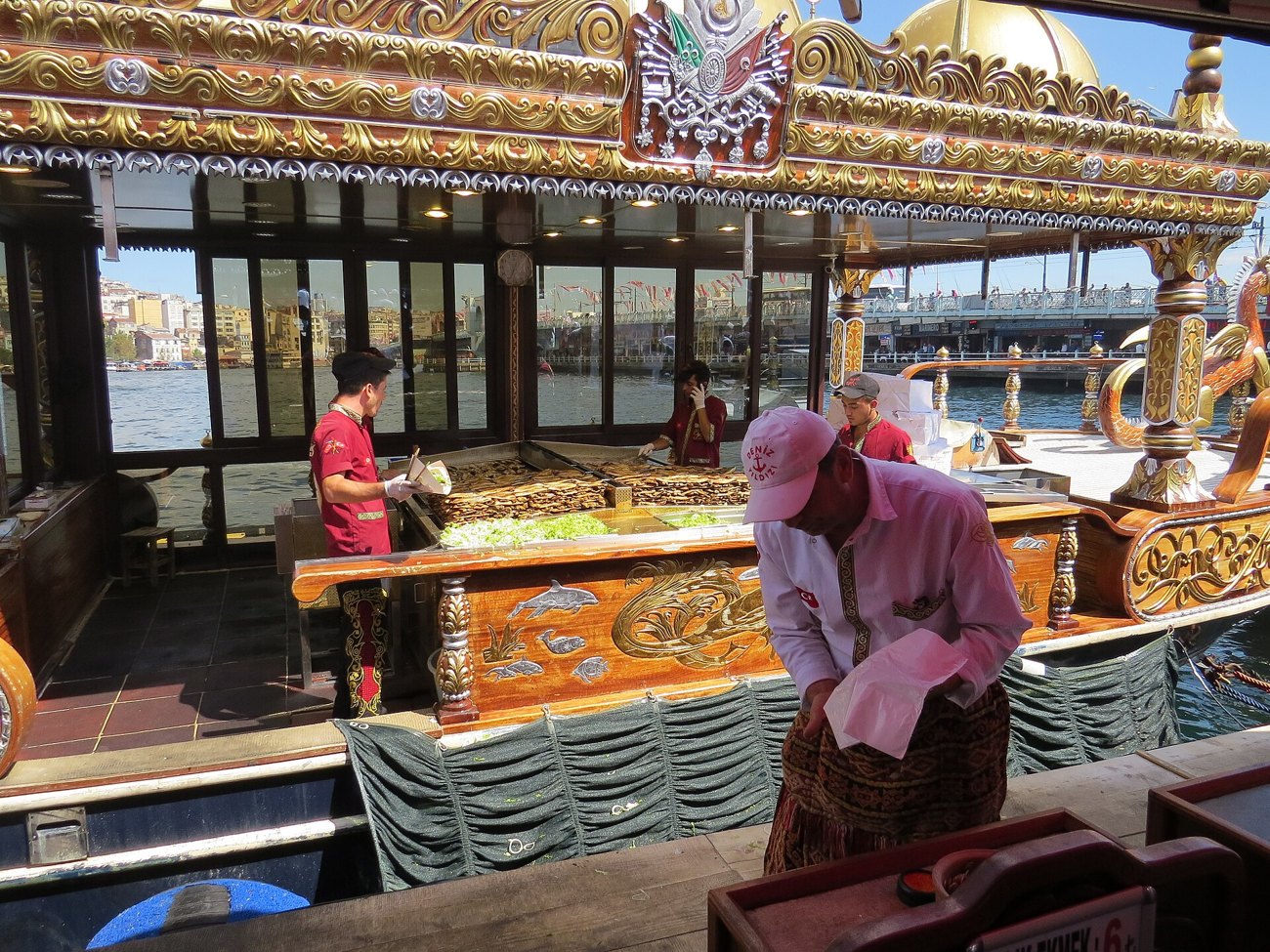
The mechanism is simple. A boat grills or fries fish on board, assembles it into a half-loaf with onion and salad, and hands it out through a serving window. Payment happens at that window, in cash. There is no seating on the boat itself — the deck is a kitchen, not a dining room. Anyone eating there is meant to eat standing, or to walk away with the sandwich wrapped.
This is worth stating plainly, because it is the detail most articles skip: the boat sells you food, not a seat. What happens next — where you sit, and who you pay for the privilege — is a separate transaction, and it is where visitors lose money.

The trap: the table isn’t the boat’s
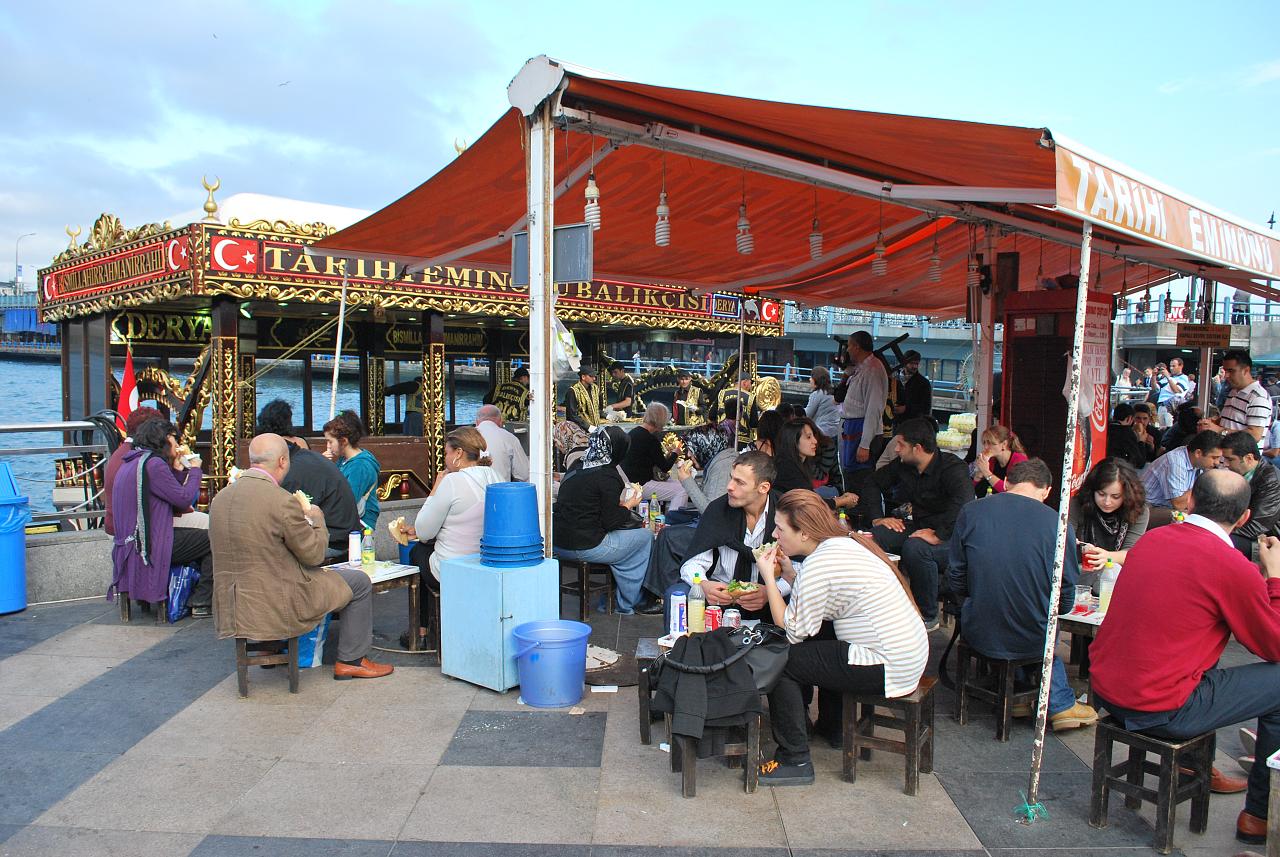
Around the boats, plastic tables and stools cluster on the pavement. Some are genuinely free public space. Others belong to a nearby restaurant or stall, and a staff member — sometimes working with the boat’s crew, sometimes independently — will wave a customer toward one after the sandwich is bought. Sitting down there is read as an order. What follows is a table charge, a service fee, or bread, drinks and side dishes nobody asked for, all added to a bill presented only once the customer is seated and settled.
None of this is illegal in itself — a restaurant can charge for its own seating and its own drinks. The problem is that nothing on the table says whose seating it is, and the sandwich transaction gives no clue either. The fix is procedural, not financial: confirm ownership of a table before sitting, or skip the question entirely by eating standing at the counter or taking the sandwich away.
| Where you eat | Who you’re dealing with | What you owe |
|---|---|---|
| Standing at the boat’s counter | The boat’s own crew | The price of the sandwich, paid once, at the window |
| Sandwich taken away | The boat’s own crew | Same as above — nothing more to settle |
| Seated at an unmarked table nearby | Usually a separate restaurant or stall, not the boat | Table or service charge, possibly unordered drinks and sides, billed after you sit |
A short exchange before sitting down settles the question: ask directly whether the table belongs to the boat or to a restaurant, and what a seat costs. If nobody gives a clear answer, that itself is the answer — stand, or walk.
.jpg)
Cash, change, and the wider pattern
Fish-boat transactions are cash businesses, and change is not always offered readily for large notes. Carrying smaller denominations avoids one common friction point. This sits inside a broader pattern of how payment works across the city, cash and card each covering different ground; our explainer on cards, cash and Istanbul’s two-tier pricing covers the split in more detail.
The same instinct that protects a visitor here — check who is actually charging you, and for what — applies to the boats moored a short walk further along the water advertising “Bosphorus cruises.” Those are private tour boats, not the public ferries, and they charge many times a standard fare for the same stretch of water a commuter ferry covers on an İstanbulkart. Our piece on why the Bosphorus ferry is public transport, not a tour lays out that distinction.
What else sits around Eminönü
The square backs directly onto the Spice Bazaar, one of the city’s working covered markets rather than a museum piece; our Bazaars & Shopping archive covers it alongside the Grand Bazaar further up the hill. Eminönü’s transport links make it a natural stop on the way to either, and our Getting Around archive covers the tram, ferry and Marmaray routes that meet here.
None of this requires a booking or a guide. It requires knowing which transaction you’re in before you agree to it — a principle that applies as much to a fish sandwich as to a museum ticket or a ferry fare. Our Planning & Practicalities archive covers the wider set of these small, checkable mechanics, and our About page explains how this site is researched and sourced.
Consumer complaints about food and service pricing in Istanbul, including disputes over unadvertised charges, fall under Turkey’s Ministry of Trade, which publishes consumer-rights guidance on its own site (ticaret.gov.tr). Eminönü’s municipal oversight, including street vending and market stalls, sits with the Istanbul Metropolitan Municipality (ibb.istanbul), which is the body to check for anything specific to the waterfront’s current rules.
.jpg)
.jpg)
.jpg)
Access Istanbul is an independent guide written from published, checkable sources. We have not visited the places described here and we do not publish personal recommendations or invented ‘local favorites’ — where something is singled out as notable, we say who says so. Opening times, fares, closures and prices change at short notice, so treat everything here as a starting point and confirm with the museum, operator or venue directly before building a day around it. We give no advice on visas, insurance, health or safety; use your own government’s official guidance for those.
Featured image: Photo by Derzsi Elekes Andor, source, CC BY-SA 4.0
